
Cal lives in one of the most exciting periods in history. 1688 is the real start of the “long eighteenth century”, a time when huge advances were made in science and commerce, and when war and revolution reshaped society. It was the time of the Royal Society, of religious toleration, and I believe it was when the idea of Britishness was created.
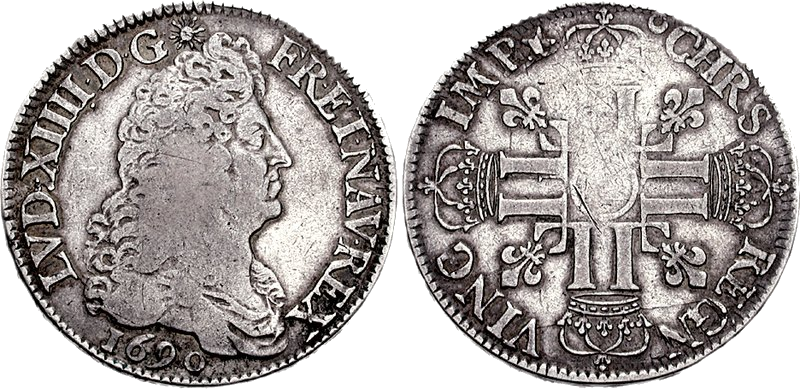
- Image courtesy of Classical Numismatic Group
The Glorious Revolution is strangely downplayed in English history. It’s often presented as a kind of genteel evolution ushering in greater toleration and democracy, but it was a very cleverly marketed coup d’etat. A daughter leading an invasion against her own father; William of Orange seeking the English throne mainly so he could better defend himself against the French; messages passing in invisible ink between Dutch spies and English noblemen until the entire postal system was suspended to halt them; complex legal manouevres to justify the coup – the story is extraordinarily dramatic.
Seventeenth century London teems with fascinating, louche and smelly stories, which are posted here regularly.
Sign up for the newsletter to receive regular updates >
Foreigners in 1688
Click image to hear “The Curette”. Image courtesy of www.executedtoday.com.
I have a strong suspicion that my father’s family were originally Huguenots who settled in the West Country. They were a curiously adaptable bunch who intermarried and integrated quickly wherever they settled, but have left traces of their culture and craft all over the Western world. I like to think that my family’s knack with languages, mimicry and “fitting in” come from them. There’s a neatness to it: we were all brought up as expat kids in Luxembourg, and experienced a much milder version of the Huguenot flight from France.
Huguenots had been coming to England since Edward VI’s charter of 1547. For the first half of the seventeenth century they were protected by the Edict of Nantes, a French royal decree giving them many privileges including freedom of worship. After 1661, Louis XIV gradually chipped away at their rights, having made a coronation vow to eradicate heresy. He revoked the Edict of Nantes in 1685, unleashing repressive measures on the Huguenots including Dragonnage – billetting dragoons in Protestant households. By 1688, over 50,000 Huguenots had come to England, only to be accused of low morals, taking work from natives, poor hygiene and worse diet. In all, a fifth of the population of France emigrated in less than a century: in today’s numbers, that would be ten million people.
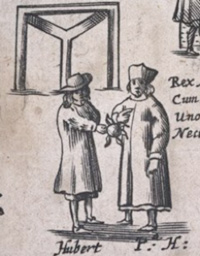
Many Huguenots were skilled craftsmen: silk-weavers, shipwrights, clockmakers. Some Londoners welcomed them, others reacted against “foreign” competition; and it was certainly far from an unqualified welcome. The Great Fire of London was blamed on Frenchmen and Papists: an innocent Huguenot named Robert Hubert was forced to confess to starting it, then hanged.
Huguenots were not the only foreigners to struggle. During the Civil War, an Irishman bearing arms in England could be summarily hanged, no matter whose side he was on.
Turbulent Thames
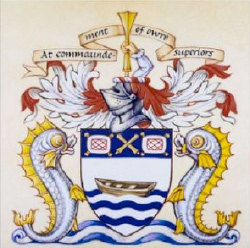
Image courtesy of blackcablondon.wordpress.com
London’s rivers roared and rollicked with activity. The Thames was packed with boats and ferries, dancing to the din of wharfmen and watermen calling for business. Great wheels pumped murky Thames water into small wooden pipes, while smaller rivers like the Fleet poured the other direction, dense with blood and rubbish and excrement. Men wrestled for sport and money on the riverbanks, egged on by shouting crowds. No rivalry was more bitter than that between the watermen (ferrymen) and lightermen (cargo carriers), especially since the lightermen had a habit of carrying passengers when their competitors weren’t watching. London’s black cabs still carry the badge of the watermen and lightermen.
This piece is an “out-take” from The Bitter Trade - I’m particularly fond of Samuel Quarry but he didn’t make the final cut. Cal and Ty are travelling upriver in a lighter, in defiance of guild law…
The lighterman’s eyes opened wide. I turned and spied a boat bearing down on us from downriver. It was a wherry, rowed fast by half a dozen thickset men, with a crook-back in the front. The same fellow who had frowned from the watermen’s wharf.
“I will outrun them,” grunted the sailor. “As my name’s Samuel Quarry, I’ll best ‘em.”
He bent to his oars and dug deep into the dust-webbed skin of the Thames, and for a moment he pulled away from the bigger boat, heading for the shore. But the crook-back called to his rowers, and their strokes grew faster. Soon they were close enough to shout, and shout the waterman did, cursing us for guild-breakers and promising to leave us at the bottom of the river.
Ty and I looked at each other. Neither of us could swim. Though the shore was growing closer, we were dead sure that we would be caught before we got there. But Samuel Quarry was strong, and with his jaw clenched and his eyes tight shut, he drove for land. We were barely five paces ahead of the crook-back’s cursing mouth when the boat’s bottom crunched on the dull pebbles of the Thames shore. Quarry flung himself sideways out of the boat, landing in a crouch on the shore and grabbing one of his oars in the same movement. I pushed Ty after him and leapt into the shallow water, dodging a blow from a waterman’s oar. We scrambled away from the lapping river, looking in vain for a nearby stairway or ladder.
But our pursuers did not land, back-paddling to stay off-shore. From the beach under the Bear-wharf downriver came whistles, and the crunching of boots on loose shale. It was a band of dock-men, armed with poles and hooks. Samuel Quarry whistled back, waving his oar, and pulled a mocking face at the angry watermen in their wherry. We waited for the dock-men to arrive, expecting their rivals to row away in time so that we could carry on upriver.
Then two more boats came fast from the far side of the Thames, bristling with rowing lightermen, and with their guild badge flying from above them, a tiny bark floating on blue waves. For a breath I marvelled that one craft could split into two warring bands, but then I thought of the English weavers. How Garric had used my father to bring them close to their Huguenot guild-brothers, and how the Dutchman van Stijn had seen them fight together.
Now the dock-men were outnumbered, but they did not turn and run, waiting with their poles planted in the shale. Another boat was coming from our left, downriver, the half-laden barge that we had seen at the wharf. It was to be a great fight.
“A mercer may not sell silk in the dark,” said Ty piously, edging away from the battle.
Quarry’s shoulders jerked with laughter, and he hefted his oar into both hands as the two new boats joined the first band of watermen. I watched with gawking eyes as all three pulled hard for the shore, calling out challenges to dock-men they knew by name. Above us, windows rattled open as the gentlefolk came out onto their balconies to watch the contest. Wagers were called out, and one or two of the dock-men shouted up to ask for a bet to be put in their own name. I could not but smile at the foolishness of this water-guild, that punched itself in the face of a Sabbath.
Yells and jeers came down from the gentlemen on their balconies as the beatings began. Higher windows flashed in the morning sun as ladies leaned out to watch, shamelessly showing their Sunday hair without the covering of a tippet or hat. I saw that the poles and hooks and oars were put down, and that every fight was one man to one man. A handful of watermen had to wait in their boats until the barge came and there were enough lightermen to wrestle with. When a man had been knocked down hard enough to stop him rising, he was clapped on the back and rolled away from the mob. Samuel Quarry knocked down three of the watermen before he was felled by a groin-kick from a barrel-chested midget.
We did not return until deep into dusk. The shore seemed to lengthen with our shadows as the Tower appeared, a tiny sharp-sided shape seeming to cling to the London-bridge like a fraying cuff to a beggarman’s sleeve, never drawing closer no matter how long we walked. At last we came to the place where the watermen and lightermen had fought, marked by a jumble of boxes and abandoned jerkins. We drew closer, and saw then that the bundles were in truth Samuel Quarry and the crook-back waterman, slumped against the shore-wall with their arms around each others’ shoulders, a pair of corked flasks nestled in their laps. The reek of gin stung the air in our nostrils.
“They’ll drown,” I whispered to Ty.
He shook his head, pointing at the tide-mark below where they lay.
In his sleep, Quarry leaned his head over and planted a kiss on the crook-back’s wispy grey hair. We laughed quietly and I crept up on the two drunkards, twitching their gin-flasks away without stirring their limp hands.